When a retailer’s point-of-sale system crashes, the fallout is lost revenue. When a hospital’s network fails, the consequences can be catastrophic: ICU monitors freeze, diagnostic imaging is delayed, telehealth appointments drop mid-session, and clinicians can’t access electronic health records (EHRs).
That’s why network resilience has rapidly moved from an IT talking point to a board-level mandate across the healthcare sector. According to C1 and Hanover Research, 91% of enterprises now say network resilience is a C-suite or board-level issue and in healthcare, the stakes are higher than anywhere else.
The latest research shows that healthcare providers are prioritizing uptime, compliance, and security at significantly higher rates than other industries. This blog unpacks how healthcare compares, where providers are investing, the unique barriers they face, and why modernizing networks has become a patient safety imperative.
Benchmarking Healthcare vs. Cross-Industry
Healthcare organizations share many of the same IT infrastructure modernization pressures as finance, manufacturing, and utilities. But the data shows clear differences in emphasis:
- Reliability/Uptime: Healthcare respondents ranked uptime as a major priority at a rate 12% higher than the cross-industry average, reflecting the direct connection between outages and patient safety.
- Reducing Operational Costs: With razor-thin margins and shifting reimbursement models, healthcare leaders over-indexed by 8% compared to peers when citing cost reduction as a top driver of investment.
- Compliance and Security: Healthcare respondents placed greater emphasis than any other sector on regulatory compliance, aligning with HIPAA and patient privacy obligations.
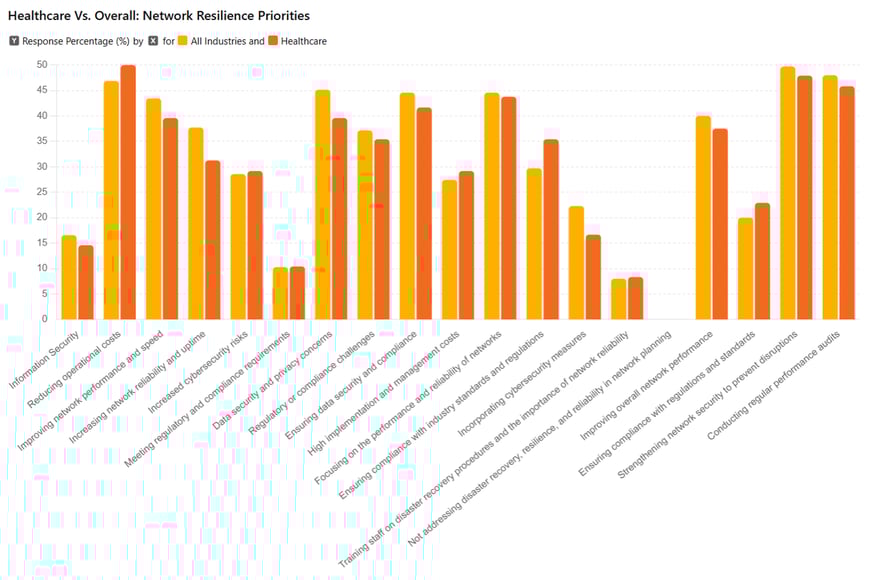
In short: while all industries are chasing performance and speed, healthcare is doubling down on resilience and compliance because lives, and reputations, depend on it.
The Driving Forces Behind Healthcare’s Network Push
Several macro and sector-specific forces are accelerating the shift:
- Telehealth and Remote Care Expansion
Virtual visits surged during the pandemic and remain a core part of care delivery. Dropped connections translate into lost revenue and diminished patient trust. - Data-Heavy Workloads
Imaging files, genomic data, and AI-driven diagnostics are massive. Legacy networks struggle to handle the throughput. - Distributed Facilities
Large healthcare systems now span hospitals, outpatient clinics, specialty practices, and home health providers. Seamless, secure healthcare connectivity across sites is mission-critical. - AI in Clinical Workflows
From predictive analytics to radiology AI, machine learning tools require consistent, high-speed, and secure data access. - Patient Safety and Compliance
Unlike retail or manufacturing, where outages hurt productivity, healthcare downtime can trigger sentinel events, HIPAA violations, and loss of accreditation.
The takeaway? Healthcare networks must do more than connect devices, they must safeguard the continuity of care.
Investment Priorities: Where Healthcare Leads, and Where It Lags
The research revealed the technologies healthcare providers are prioritizing most, compared with the overall industry:
Leading the Charge
- Wi-Fi 6/7: Healthcare respondents invested at a rate 5% higher than average, driven by the need to support thousands of devices in dense hospital environments.
- 5G Connectivity: Adoption is particularly strong in healthcare, where use cases like connected ambulances and rural telehealth require mobile bandwidth and low latency.
- Edge Computing: Healthcare is outpacing other sectors in exploring edge for imaging, diagnostics, and connected devices that cannot tolerate cloud latency.
Falling Behind
- Network Automation Tools: Despite potential efficiency gains, healthcare adoption is 7% lower than peers, likely tied to staff shortages and complexity concerns.
- WAN Optimization: Investment lags in this area, leaving some organizations vulnerable to bandwidth bottlenecks across distributed facilities.
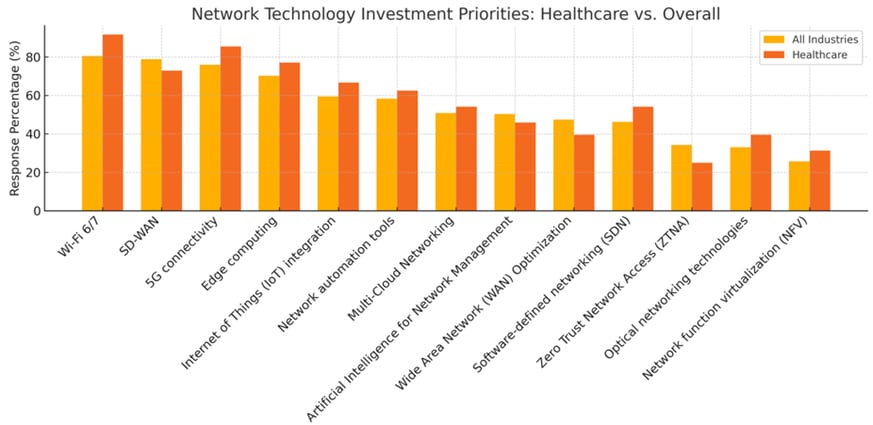
In other words, healthcare is leaning into patient-facing, high-density, low-latency technologies but needs to accelerate adoption of automation and optimization to free up strained IT teams.
The Tightrope: Balancing Modernization with Care Continuity
Across industries, 45% of organizations say their top challenge is modernizing the network without disrupting operations. In healthcare, the challenge is amplified:
- Hospitals can’t close wards to improve healthcare infrastructure.
- IT staff often deploy changes overnight to avoid clinical disruption, driving burnout.
- Many facilities still rely on legacy cabling and architecture, complicating upgrades.
The research also showed healthcare leaders reporting staffing shortages and vendor support gaps at higher rates than their peers. That means modernization isn’t just about deploying new tech, it’s about finding partners who can minimize disruption, fill expertise gaps, and ensure compliance.
Not Going It Alone: The Rise of Hybrid and Outsourced Network Management
The survey revealed that 72% of organizations augment internal IT with external resources or third-party providers. Healthcare respondents leaned even more toward this model, reflecting the dual pressures of compliance and staffing shortages.
For providers, external partnerships deliver:
- 24/7 monitoring and rapid incident response.
- Specialized HIPAA and healthcare compliance expertise.
- Predictable service-based models that ease capital constraints.
- Disruption-minimized rollouts using proven methodologies in live care environments.
The message is clear: healthcare IT leaders cannot shoulder this burden alone. Strategic partnerships are becoming the new norm.
Case in Point: When Healthcare Networks Resiliently Deliver
While the research quantifies the challenge, real-world examples show how network modernization drives patient outcomes:
- Zero-Disruption Migration: A major health system partnered with C1 to refresh its firewall architecture across multiple hospitals, completed without downtime or interruption to clinical systems.
- Community Hospital Upgrade: A midwestern provider transitioned to SD-WAN to connect rural clinics, enabling seamless EHR access and secure telehealth expansion.
- Senior Living Provider Modernization: Brewster Place implemented a secure, scalable Wi-Fi 6 upgrade to support telehealth, resident wearables, and staff mobility.
Each case underscores the same truth: network resilience directly supports patient care, staff efficiency, and organizational trust.
The Roadmap: Building a Resilient Healthcare Network
For healthcare CIOs and IT leaders, here’s a practical roadmap aligned with the research findings:
- Assess and Benchmark
- Audit uptime, latency, and failover capabilities.
- Map dependencies between critical systems (EHR, imaging, monitoring).
- Prioritize Mission-Critical Services
- Classify applications by patient safety risk.
- Ensure redundancy and high-availability architecture for the most critical systems.
- Modernize Strategically
- Deploy Wi-Fi 6/7 in dense hospital settings.
- Roll out SD-WAN to unify multi-site connectivity.
- Use edge computing to accelerate imaging and diagnostics.
- Embrace Managed Services
- Engage partners for round-the-clock monitoring.
- Outsource compliance and security expertise where in-house resources are thin.
- Build a Culture of Resilience
- Conduct regular downtime simulations with clinical teams.
- Train staff on escalation protocols and failover processes.
- Align C-suite, IT, and clinical leadership around resilience goals.
The Boardroom Imperative: Resilience = Patient Safety
The biggest shift reflected in this year’s research is that network resilience has entered the boardroom. Healthcare boards are asking tougher questions:
- How are we ensuring uptime in critical systems?
- What are our failover strategies for EHR downtime?
- Are we positioned to scale securely with AI and telehealth?
For healthcare providers, the answers tie directly to patient safety, trust, and regulatory compliance.
Conclusion: Healthcare Can’t Afford Fragile Networks
In every industry, resilience has become the defining network metric of 2025. But in healthcare, resilience isn’t about competitive advantage, it’s about saving lives.
The data is clear: healthcare leaders place more weight than their peers on uptime, compliance, and cost pressures. They’re investing heavily in Wi-Fi 6/7, 5G, and edge computing, but must accelerate adoption of automation and WAN optimization to close the gap.
The providers who modernize now, while partnering with trusted experts to minimize disruption, will be positioned to deliver safer care, scale innovation, and earn patient trust in the digital age.
The backbone of care is the network. Resilient providers will lead the future of healthcare.